Joan Website | Joan Bio | Joan Licensing Info | Joan Contact Info | Blog Main Page

Art Licensing by artist Joan Beiriger: I'm happy to share art licensing info but please
give me credit and link to my blog when using it on your site. Thanks.

Showing posts with label Marketing. Show all posts

Sunday, September 14, 2014

Art Licensing: Illustrator Johanna Basford's Success in Marketing Art Outside-the-box


Two years ago I posted "Art Licensing: Marketing Art Outside-the-box" where I discussed why an artist needs to market her/his art so that its stands out from the competition. In the article, I showcased United Kingdom illustrator Johanna Basford and how she marketed her art outside-the-box by bombarding Starbucks with her intricate and gorgeous black-and-white illustrations drawn on their paper cups. It worked so well that she was commissioned to create wallpaper for Starbuck's London Vigo Street store in time for the 2012 London Olympics and the Queen's Diamond Jubilee.

Johanna has a very impressive and long list of clients including Crabtree & Evelyn, Absolute Vodka, Angostura Rum, Hallmark, Johnson & Johnson, H& M, Nike, Channel 4, Sony Music, and even Mercedes Benz Smart Car. She has continued her thinking outside-of-the box marketing and last year she created her own innovative way of selling her art on products with her Wonderbeasts project. Individuals made pledges via Kickstarter to get gifts (signed postcards, silk screen prints, etc.) with her Wonderbeasts illustrations (insects and creepy crawlies, birds and feathers, woodland creatures, reptiles, deep sea dwellers, safari animals) on them. The project culminated with the publication of Joanna's Wonderlands book of her Wonderbeasts illustrations and gave credit to those that made pledges. For more information about her successes and her Wonderbeasts project, read "Johanna Basford - Wonderbeasts".

Read Johanna's blog to find out what is going on in her studio, see more examples of her amazing work, her complete client list, etc.

Promoting Company Brands with Art
• Starbucks
According to Starbucks, people have been decorating their paper cups for years. But, because Johanna used social media to publish her outside-the-box marketing with her beautifully decorated cups it really caught the publics attention. Not only did it promote Johanna's art but it also promoted the Starbuck brand.

In April 2014, Starbucks decided to promote a white cup contest with the winning design to be printed as a limited edition of Starbucks reusable plastic cups. It generated over 4000 entries in three weeks. And in case you wonder, Johanna Basford did not win the contest. I do not know but she may not have even entered it. For information about the contest, read "Starbucks Invites you to Decorate Its Iconic White Cup". For information on the person who won the contest read, "Starbucks Announces the Winner of its White Cup Contest".

• Chipotle Mexican Grill
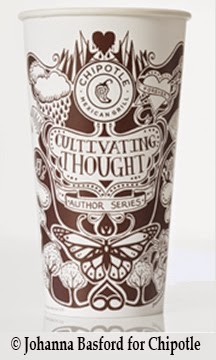
In 2014, Chipotle Mexican Grill started promoting and distinguishing its brand with their Cultivating Thought / Author Series initiative of prose written by well known authors and printed on their paper cups and bags. Black-and-white art created by different artists also embellishes the cups and bags. The marketing idea came from author Jonathan Safran Foer who pitched the idea to Chipotle's CEO Steve Ellis as a way to enhance the customers dining experience. More information about the initiative can be found by reading "Why Chipotle Wants You to Read Its Cups and Bags".

Note: Johanna Basford may not have gotten her art printed on Starbucks cups but she does have a design on Chipotle's cups and bags. She illustrated Nobel Prize winner author Toni Morrison's prose.


Conclusion
I love to read about successful artists especially when they use innovative ways to promote their art. In today's market to be successful artists need very unique art so that it stands out. Also it really helps if artists use outside-the-box marketing to create a buzz.  Johanna sure is creating a buzz! She does commission work and also sells directly to the consumer via the Internet.  And, selling her work is no easy task because black-and-white illustrations are a harder sell than if they were vibrantly colored even though her illustrations are outstanding!  Johanna has proved that being focused, working extremely long hours, and doing clever marketing can turned artistic and marketing talent into a successful business.

This article was updated 7/17/18.

Your comments are welcome. Click on the comments section (below) to write your comment. Note: Some people have a problem in leaving a comment. The most successful method is to comment as Name/URL (your name and website or blog with a "complete" URL address).

Wednesday, September 11, 2013

Art Licensing: Avoid Spam Trigger Words in Emails

Corresponding via Email is the number one method in contacting persons in the art licensing industry. And, if those Emails end up in the recipients junk folder instead of their inbox, possible licensing consideration of art and important information may never be seen. Thus, it is important to know the words that should be avoided in the subject line and in the content of the Email that will trigger it as spam. Spam filters constantly change and depends on the recipients Email gatekeeper. As stated in "Spam Filters: The Truth about Email Marketing Gatekeepers", they block not only words but also symbols, writing in all caps, aggressively urgent language and especially trigger words in subject lines.

Some spam words are innocuous such as now, never, success, sample, deal, hello while others are more obviously as spam such as free, earn $, income, get, urgent. It is impossible to avoid all the words on spam lists when writing Emails. One word will not trigger it as spam but it will if the Email is over loaded with too many or the same word or phase is repeated too many times. Also avoid sending Emails with only a few words, or only a link to a website, or only one picture because spammers constantly do it. And, most importantly focus on the subject line of the Email. Avoid spam words but make sure it is engaging so that the recipient will read it. Below are links to lists of spam trigger words.

Spam Trigger Words
• "The Ultimate List of Email SpamTrigger Words"

• "Common words that trigger spam filters"

• "Spam Filters: The Truth about Email Marketing Gatekeepers"

• "A List of Common Spam Words"

Note: There are online tools that analyze Email content to test for spam trigger words. I have not used them because they require you to enter your Email address. I am leery that I may get spam if I give them my Email address since many are selling Email marketing services. But, if you are interested, checkout "Top Sites about: Spam Checkers."

Your comments are welcome. Click on the comments section (below) to write your comment. Note: Some people have a problem in leaving a comment. The most successful method is to comment as Name/URL (your name and website or blog with a "complete" URL address).

Sunday, August 4, 2013

Art Licensing Editorial: What can artists, designers and cartoonists learn from the creator of Garfield?

Most people are aware of Garfield the cat comic strip character created by Jim Davis and that it is wildly popular and continuously earns many millions of dollars from movies and licensed products each year. But what many people do not realize is that Garfield's success did NOT happen by chance. Jim used a strategic plan by thoroughly researching the cartoon and licensing industries and applying what he learned to fill a niche. Jim admits that his Garfield cartoon is "static," is “essentially a formula,” and his intention was to "come up with a good, marketable character".

Creative director Caroline Zelonka who worked on advertising for Petsmart stores in the mid-90s recently commented in "Is Garfield Supposed to be Funny?" about the true story on why Garfield was created. In reading the article, it became apparent to me that using a strategic plan to license art is very important now more than ever because of lower licensing revenue and more competition in getting deals. Using what I call the "shot-gun" method of indiscriminately sending art to manufacturers for licensing consideration is not effective.

What learned from the article
Below are a few points on what Jim Davis did to bring Garfield to stardom and how his strategy can be used by artists, designers, and cartoonists to increase licensing potential.

• Research what is popular and why

– what Jim did: He thoroughly researched the cartoon industry and used the popular Peanuts cartoon strip as a model. He discovered that
1. the most popular and licensed character was Snoopy and not Charlie Brown,
2. there was no popular licensed cartoon character for cat lovers, and
3. the more mundane the character that does not offend anyone is the most popular and licensable. For reasons why, read "Where popularity never meets critical acclaim: Why bland entertainment is worth a fortune."

– what artists can do: Artists should target particular product industries (greeting cards, jig-saw puzzles, decorative flags, art prints, etc.) and decide where their art is a good fit. They should learn everything they can about the industry they plan to contact such as what art themes are popular. Whenever possible, contract licensee art directors and ask questions. For more information on licensing strategies, read "Eight Steps to Become an Art Brand".  Note: If you are new to licensing or have trouble in getting deals, hire an art licensing consultant to get constructive criticism of your art and suggestions on what manufacturers you should contact.

• Spend more time marketing than creating
– what Jim did: Jim spent 13 or 14 hours a week writing and drawing the strip, compared with 60 hours a week on promotion and licensing.

– what artists can do: Obviously licensing your creations are not a 40 hour work week. Jim spent four to five times the amount of time promoting Garfield than he did creating the comic strip. Spending a lot of time promoting it sure worked for him. Most artists spend more time creating their work than promoting it - including myself. The Garfield story is a good reminder that we artists should spend more time promoting our work to gain visibility and increase the potential in getting more licensing deals.

• Have visibility
– what Jim does: Jim uses the cartoon strip and Garfield movies to keep Garfield in the public eye to sell licensed merchandise. But he is very leery of over exposure and controls it as much as he can. For more information, read "Garfield: Why we hate the Mouse but not the cartoon copycat".

– what artists can do: Artist can gain visibility of their art by submitting press releases, advertise in trade magazines, exhibit at SURTEX, have a website, use social media such as blogs, Facebook etc., have online stores such as Etsy, Zazzle, Cafe Press etc. Also read, "Art Licensing: Marketing Art Outside-the-box". Artists can also gain visibility by constantly submitting art to manufacturers and by following-up. Read "Art Licensing Tip:What does follow-up really mean?"

Summary
All the above points have been made many times before. But how many artists actually implement them? Do you have a strategic plan on what products your art should be on? Do you spend more time marketing your art than creating it? Do you consistently contact your licensees and follow-up? If you do not, maybe by doing so you will get more licensing deals ;)

Your comments are welcome. Please click on the comments section (below) to write your comment. Note: Some people seem to have problems leaving a comment. The most successful method seems to comment as Name/URL (your name and website or blog complete URL address).

Monday, April 22, 2013

Art Licensing: Building a Brand

In the past, a tag line and / or logo was what identified a brand. But, in recent years many brands also use a person or character to build a relationship with their target audience. And, many brand building experts state that it is easier to build a brand around a person than an inanimate object such as a logo. People naturally respond to a person they like and tend to build a relationship with them while it takes a long time to market a logo to get the same consumer reaction. That is why a person (s) or character is often associated with the brand such as Ronald McDonald for MacDonalds fast food chain, Flo* for Progressive auto insurance, Dave Thomas (before his death) for Wendy's fast food chain, and the Maytag repairman** for Maytag washing and drying machines.

* "The Popularity of Progressive's perky insurance clerk shines again"
** "The Maytag Repairman"

The same technique can be used by artists to build their brands. Artist Thomas Kinkade knew how important it was to market himself to extend his art brand. He did a copious amount of personal appearances, youtube.com videos, and made sure that pictures of himself were placed in advertisements, press releases, and on products. Thus, even though his tag line "painter of light" is the most recognized method in identifying the Thomas Kinkade brand, a picture of Thom on product hang-tags is also a very important identifier. Note: Even though personal marketing is important to extend a brand, all the other methods used in branding is also valid.

Below is a list of excellent resources about what is branding, various ways to brand, and interesting articles about several "super" licensed brands. Not all the articles are aimed at the art licensing industry but they do contain valuable information and can be applied to branding art.

• Art Licensing Branding
– "Brand Yourself for Success in Art Licensing Teleseminar with Paul Brent"

– "Licensing: Brand Building with Marketing that Really Counts!" article by Linda Mariano art licensing and branding consultant

• Articles in License Global magazine issues about super brands  - these take a while to start.
– "Swimming with a Savvy Shark" (p. 30-31) Discussion on branding and tips from Daymond John of reality TV show "Shark Tank."

– "Brand Stars" (p. 22-24) Discussion on brands, marketing and products that are on television including the reality TV show Fashion Star.

– "Kathy Ireland Super Brand" (p. 60-62) Discussion on how kathy Ireland became a super lifestyle brand with $2 billion in retail sales of licensed products in 2011.

• Articles on branding by marketing and branding expert Susan Gunellus
– "What is a Brand? Part 1: 5 Factors that Define a Brand"

– "How to Brand - Part 1: Research the Market and Consumers"

– "How to Brand - Part 2: Identify Brand Values"

– "How to Brand - Part 3: Create Brand Messages and Brand Images"

– "How to Brand - Part 4: Educate People about Your Brand"

– "How to Brand - Part 5: Devlop Emotional Involvement and Branded Experiences"

– "How to Brand - Part 6: Monitor Brand Perception"

Your comments are welcome. Please click on the comments section (below) to write your comment.

Wednesday, March 27, 2013

Art Licensing: Marketing Art with Blogs

A major key to license art is to get your art out into the world so that clients and consumers are aware of it. And, ways to gain visibility is to actively market your art with publicity (news releases, advertisements, exhibiting at trade shows, etc.), having art on products at retail, and networking via social media such as Facebook, Linkedin, blogs, and twitter. Writing a blog is considered one of the best ways for people to get to know and connect with you. It is also a good way to market your art.

Artists are often hesitant to start a blog because they heard that you need to produce a post each day and they just do not have the time. However, blogging is still an effective marketing tool even if you do not post daily or weekly. For more information about how often you should post, read founder and editor of ProBlogger Blog Tips Darren Rowse's article "You Must Post Every Day on Your Blog (Misconceptions New Bloggers Have #2)."

Creating a Blog
Even if you want to have your own blog, you may not know what to write about. Some artists use a blog to showcase their art, and/or show their licensed art on products, and/or discuss how they get inspiration to create their art. Others use it to voice their opinion, interview people in the industry, or share information.

Blog articles do not need to be long but should contain content. Some blog experts state that a good blogger uses the 60/20/20 rule. 60% of the content of the blog should be useful information for the target audience, 20 % should be used to promote others and 20% to promote yourself. They also suggest that each article include a picture(s) to create interest. Note: This is one way an artist can market their art by using the art to illustrate the content in an article.

Enticing Readers to a Blog
Having engaging and varied subject matters entices readers to view blogs. Some bloggers may give away free things, have contests and drawings, have a blog hop (see below for an example), list resources, give tips, and show how-to-do something. Also using keywords in blog articles to optimize search engines helps drive readers to the blog. For more about search engine optimization (SEO), read "Search Engine Optimization and Blogging."

Below are some examples of blog posts that artists, agents and manufacturers have used to drive traffic to their blogs.
• Product Drawings (Sweepstakes) and Free Items
– manufacturer Clothworks "Valentine Quilt Kit Giveaway!"
– artist Phyllis Dobbs - "Free Patterns for Bee Yourself Fabrics"

• Tips: how-to & how-it-is-done
– artist Jane Maday - "Emerald Green"
– artist Jody Bergsma "Mysterious Aqua Blue and a Trip to the Sea"
– manufacturer Magnet Works, Ltd. - "DrinkBlots - Made in St. Louis, USA"

•  Interviews of artists, manufactures & retailers; Sharing art licensing resources & view points

– artist Alex Colombo (The Moon from my Attic, an Art Licensing Chronicle)
– agent Jim Marcotte (Art Licensing: Thoughts and Comments from Jim Marcotte)
– artist Kate Harper
– agent Lance Klass (TheBusinessofArtLicensing)
– agent Maria Brophy – artist Patti Gay (illustrator's Market)
– artist Tara Reed (ArtLicensingBlog)

• Blog Hop
Blog hops are a list of links that a group of bloggers post on their blogs so that readers "hop" from blog-to-blog and see the same theme on each blog. Successful blog hops have an interesting theme that is an incentive that drives traffic to each blog. A good example of a blog hop is by artist Aaron Christensen and 11 other artists that showcased their studios in 2012 "Hi Resolution - A New Year's Studio Meet and Greet."

Creating Successful Blogs
A simple rule that I have often heard about creating successful blogs is to post a picture, post often and post short (length of article). But just like many things in the art licensing industry it depends upon the usage and circumstances. Not all posts need a picture but for art blogs it sure is a good opportunity to market art. And, posting often and short can mean different things to each person. Thus, it is up to the blogger to make the decision how often she/he should post and how long the articles should be.

Read "How to Be a Successful Art Blogger: 7 Effective Blogging Strategies for Artists" by Dan of emptyeasel.com.  In his discussion about successful art blogs, he states that:
1. Create an art blog that is NOT a 'personal" blog,
2. Treat your blogging time as a business time
3. Be a content creator, not a content recycler.
4. Keep a schedule of upcoming topics to write about,
5. Don't just write about yourself and your artwork,
6. Point to good resources whenever you find them,
7. Re-read and edit each post before you publish it.

Blog Software
Two of the most popular free blog software is WordPress and Blogger. To find out about them and others, read "2013 Best Blog Software Comparisons and Reviews."
http://blog-software-review.toptenreviews.com/

Your comments are welcome. Please click on the comments section (below) to write your comment.

Monday, February 25, 2013

Photoshop Tip: Creating an Animated .gif File Slideshow

A good way to capture attention is to place a short slideshow of your best work on your website, blog, iPad, smart phone or even e-mails. A slide show is eye-catching and a good marketing tool as long as it is short and used strategically (i.e. not used too often on a site or placed where it distracts from the main objective). Customized slide shows can be created for you by service companies such as myesig.com or you can create your own with Adobe Photoshop by using the animation tool and saving it as a .gif file. The advantages in having a company created slide show is that their services include faster download of the slideshow, linked buttons and button statistics.

Note: A draw back to animated gif file slideshows is that not all operating systems support it. For instance, an animated gif file slide show on a Mac with OS snow leopard does not work in MacMail (email browser) and neither does Windows OS 7 in the Windows Picture viewer on a PC. Only the first frame of the slideshow is displayed. Thus, it is best to start the slideshow with the image you want everyone to see just in case the viewer cannot see the rest of the images.

A file with many layers (images) can be large and take a long time to download. So a slideshow should not have too many images. Also, you should save the files as low resolution (72 dpi) and in a small dimension. But, the size of the images depends on what device you are using it on. For instance, for a website the size of each image probably should be at least 3 or 4 inches at 72 dpi so that it can make an impact but for an email 1 to 2 inches may be sufficient because a smaller file for a faster download time is very important.

The following is the Photoshop steps used to create the animated .gif file slideshow shown at the top of this article. I used square images but any dimension can be used.


A. Format the images
Three square images were chosen for my slideshow. Since this is for a blog, I decided to format them for a 3 by 3 inch images at a low resolution of 72 dpi.
1. Open a new Photoshop 3 by 3.125 inch file at 72 dpi. The extra 0.125 inch will be used to insert copyright and identification text at the bottom of each image.
2. Drag each of the three image files into the Photoshop file. The size of the original image does not matter because it will be resized to fit the file size IF in Photoshop general preferences the "Resize Image During Place" box has been selected.
3. There are now four layers; background, and three art images. Delete the background layer.
4. Move the first image to the top.
5. Use the bucket tool to fill the space at the bottom of the image with white.
6. Type the image identification information and copyright on the white rectangle. I used Helvetica 11 pt font.
7. Merge the text onto the image layer (Command E).
8. Repeat steps 4 - 7 for each of the other images. There are now three image layers.

B. Animate the slideshow
1. Go to Window/Timeline (in Photoshop CS6 version) to open the Timeline menu. Or if you have an earlier version of Photoshop go to Window/Animation.
2. Click on "Create Frame Animation" button in the Timeline window. One image is now shown in the window.
3. In the upper right corner button of the Timeline window, select "Make Frames from Layers." All three images are now shown. The position of the images displayed can be adjusted by dragging the images.
4. The animation can loop forever or the number of times you wish. Select the Once button at the bottom of the timeline window to select what you want. I chose forever for my slideshow.
5. Set the length of time each image is shown, by clicking the drop down sec button below each image. All images will be set to the same time if you select each image in the Timeline window by holding down the shift key and then selecting the time. I used 2 seconds per image for my slideshow.
6. Test out the slideshow by clicking on the right arrow at the bottom of the Timeline window.

C. Save the slideshow
1. Save the file by selecting File/Save for Web.
2. Select GIF and press Save.
3. Name the file and press Save. The size of my animated gif. slideshow is 106 KB.

Your comments are welcome. Please click on the comments section (below) to write your comment.

Wednesday, January 2, 2013

Licensing: Brand Building with Marketing That Really Counts!

This must read article by marketing expert Linda Mariano discusses why each person is a brand and lists ten key points necessary to market a brand. With a career that spans 30 years, Linda is a leader in marketing, brand management, e-commerce and promotion initiatives. Read Linda's profile for a description of her skills in driving business and building brands for organizations and licensors including Thomas Kinkade. She is managing director of marketing at Redwood Media Group.  The company helps artists grow their business.


Brand Building with Marketing That Really Counts!
by Linda Mariano
Managing Director of Marketing 
Redwood Media Group
linda@redwoodmg.com

Have you ever thought of yourself as a brand? Well – time to start! Every person – artist or otherwise – IS a brand. Everything you do is a representation of you as a brand – what you think, wear, eat, who you love, who you know, your profession – every element is the essence of you as a brand. As Andrew Carnegie said many years ago: “Young man, make your name worth something!” Even Buddha gave this sage advice: “Wise men fashion themselves.”

When people see you, read your blog, visit your gallery or studio, see products with your artwork – all of it is a reflection of you as a brand. Whether the artwork is brandable or not is not the point – the point is representing yourself, your work, your gallery, your studio, all of it with consistency. All of those elements - and more - create a branded image. It’s Happy Bunny is branded artwork – but Jim Benton (the artist who creates It’s Happy Bunny) is also a brand unto himself. And quite frankly, that’s how he got started – by branding himself consistently and getting his work out there. Telling his story over and over again – created Jim Benton as a brand. Then there was viability for It’s Happy Bunny.

Ask yourself: What makes some marketing stand out in a crowded marketplace? Is it the brand or the way it is positioned? Perhaps you have never considered that you are a brand – that everything you do is a reflection of that brand. And that is where marketing that really counts begins. So have you thought about you as a brand and how it is perceived? What are the key elements of your brand? Are they recognized by your customer? Creating marketing that is in sync with your brand and reaches your customer are the two most important keys to success.

Artist, Gallery Owner, Art Publisher, Agent – no matter how you are involved in the art industry – you can use this list to evaluate your marketing on a continual basis and be on your way to creating marketing that counts – and building your brand!

1. Make your brand evident in everything you do!
Be consistent. Always use your logo – it can define who you are and make you stand out. And add a descriptive tagline that tells more of the story. You want to take the opportunity to give the collector or consumer more information in a catchy appealing way. Build their interest. And always make sure that the logo and tagline describe what you do and who you are. “Coca-Cola, Open Happiness” – “Home Depot, More Saving, More Doing” – “Mastercard, Priceless” – all great examples of how they are creating a brand message every time you see their marketing.

2. Make sure your brand translates to your customer
The way you position your brand is a critical component to capturing their attention. Your ad, your flyer, your signing, every element of your marketing should begin to tell the story of the art, the artist, the gallery – you! Giving a frame of reference, making sure it is easily understood and memorable and using great on-trend colors and design captures attention. And once you have captured their attention, your audience is intrigued and begins to experience the brand and your marketing message. And you have started to create something that is memorable.

3. Tell your story – engaging interest on every level
So you’ve got their attention, now what? Now you tell the story behind the brand and its relevance. Ideally the tagline starts the story, the colors and design of the logo reinforce the story, and now you need the one or two sentence description about the artist and their inspiration or the Gallery and who and what it features. A few examples that illustrate the brand and story concept: “Britto: Art is too important not to share” – “Wyland, Marine Life Artist: Reaching out to people everywhere with a message of art, nature, and community” – “LeRoy Neiman, Contemporary Artist: Indelible images defining the 20th Century” – “John Scanlan, Windows to the World Fine Art Photography”.

4. Sync your marketing strategy with your brand
Now you need to evaluate – everything you are doing. What, why, how, when are you doing it? Remember this old adage: “If you do what you did, you’ll get what you got – but the results will be less.” And taking a step backwards is not what you need in today’s fast paced marketplace. So if you have a “tried and true”, it’s time to refresh it! Trying new avenues and new strategies can lead to expanding your brand and reaching new customers.

5. Determine the best marketing strategy for reaching the target customer
You need to identify your customer. Are you trying to reach a repeat customer or a new customer? Remember that your database of needs replenishment on a constant basis. Statistics tell us that attrition and the economy makes even the effectiveness of even the very best list of customers decrease by 15% or more each year. Getting a new customer means thinking outside your normal demographic – think about new affiliations, partnerships, non-competitive markets and businesses.

Your marketing plan is key to maximizing your reach and bringing in new and repeat customers. There are the traditional marketing avenues: print ads in newspapers and magazines; TV and radio; direct mail catalogs, postcards and letters; flyers and hand-outs; and the phone for re-connecting with former customers and making cold calls. Sending out regular attention-grabbing press releases can get you free exposure in local publications. Of course, don’t forget social media marketing! Be there on Facebook, LinkedIn, Twitter, and Pinterest.

Give everything an updated look – and grab your audience’s attention! Start with an attention getting headline, add a powerful image. Create copy that sells and make sure you have a call to action with a strong incentive that warrants action.

Remember it’s a CAMPAIGN! You need an integrated plan with multiple points of messaging. And advertise in the right venues to reach your target audience. Keep in mind that an affluent audience and high-end collectors expect high-end product and events whereas moderately priced product has a more general market appeal. In this case, repetition is a good thing – it will reinforce your branding while reinforcing your message.

6. It’s a brand new decade – differentiate your brand and marketing
Of course you have a website, but have you approached it as one of your critical marketing venues? It is essentially your online brochure or catalog – it’s the paramount place for your brand presentation. Evaluate it with the same critical eye that you would your other marketing materials. Make sure your logo is on every page, the tagline is short, snappy and engaging. Your website is THE place to tell your story – make sure it is interesting and compelling. Can you easily see what is being sold or promoted? Don’t forget the call to action. And be sure your contact information is on every page.

Do you use email campaigns? They are an easy, inexpensive way to send updates and new information. Treat them the same as you would any communication. Logo, tagline, contact information and, of course, clear directions and response capabilities. Use your email campaigns to drive traffic to your website, gallery, studio and special events.

Get your “fans” and collectors into the marketing picture! Use social networking like Facebook, LinkedIn, and Twitter to get the word out. Link everything back to your website and maybe even give incentives for participating. Create a blog and write about your area of expertise – you know what you’re talking about! It’s all about inviting comments and interaction, encouraging discussion and opinions, make it a “happening”. And the fun is you get to see what people are writing and can use it to your advantage to learn from your visitors.

And don’t forget community and charity opportunities as a way of reinforcing your brand. These can be great venues for getting to know people who support and appreciate the arts. Low cost or no cost opportunities such as open studio, gallery walks, decorator show house events, art fairs and shows, directories, and local charities where you can donate artwork to raise awareness. And they will spread the word about you too!

7. Give your customers what they want
Make sure you know what they want! You can ask them directly – or simply discover it by looking at the info you already have. Take a look at your best sellers, specific customers’ purchases, and requests for something that you do not currently offer. Now match what you learn with what you offer – maybe it’s as simple as offering a different size artwork or a different frame or a different color.

8. Integrated impression from your art, your gallery, your marketing
Make every customer a repeat customer. You want to give each and every person a reason to come back. It is really the experience that they have with you that makes you, your gallery or studio, and artwork memorable. Some even say that the artwork they take home is the “souvenir of the experience!” Imagine that great experience as a pebble dropped in a pool of water with ripples ringing out and out – that’s what can happen when your customer has a great experience and wants to tell everyone about it!

What’s happening on a daily basis in your gallery or studio? You need to have a fresh, exciting presentation that is invites the customer to want to experience more. More about the artwork, more about the artist, more about every aspect of your brand. While you may have special events and promotions, make every day an event to insure you are more effective in the way you engage your customers. And your programs and campaigns – plus that all important experience – brings them back over and over again.

9. Bottom-line - it’s your brand and the impact it makes!
Make it memorable and differentiated from your competition. Create an experience worth remembering. Create an experience worth repeating. Make the product offering and presentation exciting. Set you, your artwork, your brand apart by offering what the customer wants – making sure to add in something new or unique. As Peter Drucker, the great icon of marketing and brand management, said: “The aim of marketing is to know and understand the customer so well the product or service fits him and sells itself.”

10. Bottom-bottom-line
Don’t retreat! Get out there and be seen! In a challenging economy, aggressive new businesses win by initiating advertising and marketing strategies while their competitors are trying to save money! Remember: Keep it real – and that means relevant! Great brands with effective marketing say to people, “Here's what we've got. Here's what it will do for you. Here's how to get it.” Now get going to build your brand with an effective marketing strategy!

This article was updated 7/21/18. 

Your comments are welcome. Please click on the comments section (below) to write your comment.

Thursday, May 3, 2012

Art Licensing: Marketing Art Outside-the-box

Artists have heard and probably use the staid-and-true methods of marketing their art to gain visibility such as displaying their art on their website, exhibiting at tradeshows, sending out press releases, advertising in trade publications, having a blog and other social media such as Facebook, twitter. The problem is that although these are important and works an artist needs to market also so that her/his art stand out from the competition. The reason is manufacturers are bombarded with submissions from thousands of artists with outstanding art and an artist can get lost in the crowd unless she/he can somehow make an impression.

An astonishing example on making an impression and marketing outside-the-box is illustrated by Johanna Basford. She is a United Kingdom illustrator that creates intricate hand drawn ink illustrations. She set her sights on having her Christmas illustrations placed on UK Starbucks paper cups. She decided to market outside-the-box by bombarding Starbucks with Starbuck cups decorated with her art on it. Her story is an amazing journey of a dream, VERY hard work, persistence, and not giving up. And Johanna prevailed. After 18 months she got a deal! BUT it was not to create art for cups (yet) but to create wall paper for Starbuck's London Vigo Street store in time for the Olympics and the Queen's Diamond Jubilee. Read Johanna's story on her blog "Starbucks 16 April 2012" and view pictures of her impressive presentation and art that she sent to Starbuck. She also inspired her blog readers so much that they got involved in her mission. Besides using Tweeter and Facebook to give a thumbs-up, they wrote letters to Starbucks headquarters and left customized Christmas Cups on UK Starbucks tables. Now THAT is marketing "outside-the-box" !!!

Observation: Notice the designs, art styles, and color or lack of in the art shown in the above links. These are very different than designs found on most products in the US. Artists that have a similar art style and color pallet, might consider approaching UK manufacturers with their art.

Read the following articles for suggestions on marketing outside-the-box:

• "Interesting Example of Out-of-the Box Marketing Ideas"

• "50 Out of the Box Marketing Ideas for Small Business"

• "18 Tips To Bring Visitors To Your Artist Website"

• "Marketing Outside-the-box"

Thank you artist and friend Ellie Fidler for sending me the links to the blog posts about Johanna Basford and Jessica Hogarth. You gave me the inspiration to write this article :)

This article was updated 7/17/18.
 
Comments are welcomed. Enter them in the below comment section.

Monday, April 2, 2012

Editorial: How the Reality Show "Fashion Star" Can Help License Art

The new reality TV series "Fashion Star" that is searching for the next great fashion brand illustrates many of the same aspects that are important in licensing art.  The designer needs to know what appeals to their customers (retail store buyers & ultimately consumers), know trends that appeal to customers, create a variety of designs and still maintaining an unique look, willing to listen to mentors and customers, willing to compromise, and able to connect with the customer to build an enjoyable working relationship.  The designer can have fabulous designs but if they ignore these points they will be eliminated from the competition as some of the designers found out.  This is also true in art licensing.  Artists need to embrace the same points as the fashion designers to have a successful licensing career.

"Fashion Star" is a competition among 14 unknown fashion designers that are vying to win a 6,000,000 dollar prize to launch her/his collections in three large retail chains: Saks Fifth Avenue (high-end), Macys (mid-end), H&M (mass market).  Each week the designers are mentored by three celebrity designers and challenged with a particular task to further develop and expand their brands. For the premier week it was to present three variations of their signature looks.  Week two was to know the retailers and design clothing that their consumers would purchase.  Week three was to design clothing for the summer season.  Week four will be the challenge in designing two variations of the designers look for the high-end and the mass market. Buyers from each of the stores judge the designers creativity, if it will sell at retail, how well it will display on store racks, and whether it can be produced at a profit.  If yes, they offer a bid for the design (starting at $50,000) which can end up in a bidding war among the retailers.  The highest bidder gets the item and the designer is safe for the week.  The designers whose look was not purchased face elimination.  And the designer that makes it through the competition and is judged by all three retailers with the best brand for multiple markets wins.

By listening closely to the comments made by the mentors and retailers, gems of important information can be learned and translated to the licensing industry to improve art. During the show, buyers inform selected designers why their creation was not purchased - not good construction, does not show well, not unique enough, wrong colors and fabric, etc. The mentors offered suggestions on how to improve the look to appeal to the retail market. The designers that ignore the suggestions quickly found out they made a mistake when their creations were not purchased.  Designers that tweaked their look to appeal to the different retailers and widened their range of designs paid off in being recognized by the buyers for their efforts and having their creations purchased.  Others that gave up or thought that staying true to their look is more important were sent home. And several designers found out that there is no room for ego in the fashion industry when they clashed with mentors and buyers resulting in being eliminated from the competition.

 "Fashion Star" has brilliant marketing of products by being on national TV and with a slogan "watch it today, wear it tomorrow."  Consumers like the products and are using  social media to pass the word.  Many articles about consumer reaction to the show can be found on the internet including "Reality Show Fashion Star Boosts Macy's Sales, Builds H&M Brand Image, Busts Saks Customer Satisfaction and Misses Its Own Potential for Shopper-Viewer Engagement (M, SKS)."  And if you wonder how the retailers can offer the products on sale immediately after the airing of the show and who manufactures the products, read "Retail told - That was fast, On TV last night, in stores today."

"Fashion Star" airs on NBC - Tuesday night.  At the time this article was written, there are six remaining episodes with the finale airing on May 15.  Videos of the aired episodes can be viewed on NBC "Fashion Star" until June 14, 2012.

Share your comments about "Fashion Star" and on what you have learned.

Sunday, November 13, 2011

Advantages in using Google Reverse Image Search

I find it VERY helpful to belong to linkedin groups! Members share a lot of information and resources that I may not discover on my own. For instance, illustrator Cedric Hohnstadt in the linkedin* Art of Licensing group shared that Google now has a method called "Reverse Image Search" to search the internet for images. GRIS, an acronym that I am using in this article for "Google Reverse Image Search," was released on June 14 and has received accolades from scads of people who post images on the internet. GRIS is not perfect because it does not find all images but according to persons that have compared GRIS with another image search engine, TinEye.com, GRIS is far superior.

GRIS is very simple to use. All you need to do is drag a small (two to four inch wide) 72 dpi jpeg image from your computer desktop into the GRIS Search Images window. In seconds (most of the time) a list of internet sites that matched the image appears on your monitor IF a match is found. Also shown is a group of visually similar images according to GRIS although I did not think they looked THAT similar to the images I searched for. To learn the four ways to search the internet by image and watch a video explaining GRIS, go to "Google Search by Image." Note: In some of the articles that I read, people had problems with the drag and drop method but found that pasting a URL web address for the image in the search window worked for them.

* For information about linkedin groups, read "Art Licensing Resource: Networking in Linkedin."

GRIS Limitations
GRIS does have some limitations because the algorithms used to identify images are not perfect. GRIS tends to find images on the main page of sites better than if it has to drill down through multiple pages. Also even though Google is constantly trolling the internet it does a better job in identifying images on their sites such as Blogger than other sites because the database is more complete. As a result, GRIS may or may not identify images that you know are on the internet. But as Google continues to improve GRIS, it will do a better job. Note: I tried GRIS on some images that I know is on internet sites. It identified and listed sites for several of them but not all. I also found that the size of the image that you use may make a difference in the success GRIS has in identifying images. Read my comments about this under Reasons to use GRIS / Search for internet sites selling your art / Case History of Nutcracker Image Search.

Articles about GRIS
I got over six million hits when I googled "reverse image search google." Obviously there is a lot of interest in GRIS. Articles discussed the announcing of this new tool in searching for images on the internet, comparing GRIS with other image search methods, and asking questions about using GRIS. Below are links to some articles that I found informative.

• "Google's New 'Reverse Image Search' Helps You See Who's Stealing Your Artwork" discussion by illustrator Cedric Hohnstadt.

• "Google's reverse image search: Indies Restaurant" discussion in using GRIS to find copyright infringements by illustrator Jeff Fisher.

• "Google rolls out reverse image search: RIP Tineye" comparison of GRIS and Tineye by Stephen Chapman.

• "Putting Google's Reverse Image Search to the Test" comparison of GRIS and Tineye by photographer William Beem.

Reasons to use GRIS
The reason why most people use GRIS is to search the internet for sites that use their images without permission. But there are also other reasons to use GRIS. Below are discussions about them.

• Search for Illegal use of art.
Use GRIS to find what websites or blogs are using your art without permission and without giving you credit for the art. Some individuals may be posting your art on their blogs to give content to their articles with the mistaken idea that they are doing you a service by marketing your art on their blog. Others may be "lifting" your art and selling it as their own art or putting it on products that they sell.

It is the consensus on linkedin that no matter why your art is being used without your permission, the person infringing on your copyright should be informed that they are using your images illegally. You may choose to ask them to give you credit for the art, request that they license your art, or demand that they remove your art from their site. People that are infringing on copyrights should be educated that they are not allowed to put images owned by others on their site without permission. With GRIS, artists now have a better tool to find the sites that infringe on their copyrights and can contact the infringers.

• Search for internet sites selling your art.
It is often difficult to find out which retail stores are selling your art on products. Manufacturers track what stores they are selling to but not necessarily if your art is on the products. The cannot keep track because their client list is too large. So if you have friends and relatives ask you where they can purchase your art you will not be able to tell them. However, if the product is sold via the internet you can use GRIS to find them. More and more products are now sold on the internet. Finding out what online shops are selling your art is a good way to track how many and which stores are carrying them. Note: Licensing contracts do not always give artists enough samples or allow them to purchase the products wholesale. I have used a couple of my friendly local retailers to order my licensed art from manufacturers when I want to give them as gifts. And they have also ordered extra to sell and promote because I am a local artist that licensed my work on the products :)

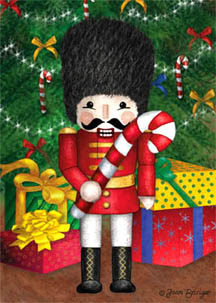
Case History of Nutcracker GRIS Search
The following is my experience when I used GRIS to search the internet for my recently introduced Christmas Candy Cane Nutcracker flag licensed to Evergreen International. I used GRIS with two different sizes of my art. The first time I used a four inch wide, 72dpi, jpeg image. GRIS found three internet stores that are selling my flags. But it did not find the image on Evergreen's website. Probably the reason is because a person needs to drill down five pages to find the art on their site. A person only needs to drill down one or two pages on the internet stores to see the image.

When I used a smaller image (2 inch wide, 72 dpi, jpeg file) to search for the image, GRIS found the initial three internet store sites PLUS two more. The next time I searched GRIS with the same smaller image it found only four sites. Hmm, as been said Googles Reverse Image Search is not perfect.

Below is the nutcracker image data from a GRIS search.  I am very thankful that this image has not yet been used illegally.


• Search for Internet sites that is promoting you and your art.
Using GRIS is one way to find out how much exposure you and your art is getting on the internet. Are bloggers posting part of your blog articles on their blogs and linking back to your blog? Are manufacturers posting your art on their websites and listing you as the artist? Are you quoted in an article which includes a photo of yourself? All these are ways that you and your art gain exposure which may help you get licensing deals.

• Use GRIS for SEO (Search Engine Optimization) link building.
Driving customers to the websites of brands has become an integral part in brand building. Large brands (entertainment, food, appliance companies, etc.) often hire SEO consultants to implement SEO projects in marketing and growing their companies. Brand building for artists is different then these kinds of brands and hiring a SEO consultant costs more than most artists can afford. However, it is instructive to read how SEOs drive customers to websites. Maybe artists can use some of SEO consultant strategies to build their own brands. Read "Reverse Image Search Strategy for Outside the Box SEO Link Building" to find out how a SEO company (Zeta Interactive) uses GRIS to drive customers to websites. Note: Not every expert in the art licensing industry believes that an artist can be a brand or that it is necessary to be a brand to be successful.

Using Google Reverse Image Search is an useful tool. Because it is not perfect, it is recommended that other search techniques also be used on the same images such as tineye.com, and googling your name plus the word images (ie "joan beiriger images").

Comments and suggestions on how to use Google Reverse Image Search are welcomed. Please click on comments and write them in the comment window at the bottom of this article.

Sunday, November 6, 2011

Creative Process of Extremely Successful Licensed Artists

Have you ever wondered why the art of successful licensed artists is so popular? Popularity is not only the uniqueness and the theme of the art but the emotion it emits. Art licensing agents recommend that artists paint what they love so that the emotion shines through. Of course, the trick in licensing art is to not only paint what you love but paint themes that resonate with consumers. And to do so means observing and researching the subjects and colors that appeal to consumers.

Also part of the process to being successful in licensing art is to create a bond between the artist and licensing partners (manufacturers and retailers) and the consumer. Having artist signings, blogs, and doing videos help to market art and create relationships.

Below are links to videos of five extremely successful artists (Susan Lordi, Jim Shore, Susan Winget, Mary Engelbreit, and April Cornell). The videos describe their inspiration and/or demonstrate their creative process of either their two or three-dimensional art. Watching these videos is not only interesting but educational.

For instance, surface designer April Cornell uses the colors found in nature to create patterns for fabrics. Susan Winget and her team of illustrators have created a process to produce a large body of outstanding art for products that consumers are clamoring for. Susan Lordi of the amazingly successful Willow Tree line of inspirational figurines does extensive studying of her subjects and takes photos before she carves a new creation. Jim Shore's comprehensive knowledge of quilting and folk art and using it on his carvings has given him a signature style that is easily recognizable. And Mary Engelbreit is now adapting her storybook art to produce short animations.


video "Inside Susan's Studio
video "My Girls Willow Tree Figurine"
video "Willow Tree Journals"


video "Jim Shore Art Influences and Style"
video "Jim Shore Workshop"


video "Susan Winget: My Creative Process"


video "KETC | Living St. Louis | Mary Engelbreit"


video "April Cornell"

To learn more about successful licensors and view videos, read "Studios of Successful Art Licensors" and "Art Licensing Tip: Branding the Art & Artist by Marketing with Videos."

Comments are welcomed. Enter them in the below comment section.

Tuesday, October 11, 2011

Marketing: Manufacturers Use Facebook to Promote Products & Connect with Customers

Connecting with others via social media is all the rage especially on Facebook. Some manufacturers that license art are taking advantage in the popularity of social media by staying in touch with their customers (retailers and the consumers who purchase their products). They use Facebook to introduce products, talk about subjects of interest to their customers, announce giveaways and contests, and link to articles and special events. Retailers and consumers comment about the manufacturer product line and ask questions on where to purchase products or give suggestions on new themes and products. To learn more about why manufacturers are using social media, read "Business Connection - Social media markets integral part of business strategy."

The Lang Company "thinks out of the box" to entice people to their Facebook Page by periodically putting on Chat Events with their artists. Interested persons can log onto Lang's Page and ask questions of the artist during the event while the artist stays online to answer them. Artist Lisa Kaus did Lang's artist Chat Event last week. Last year, I had a chance to ask artist Susan Winget a couple of questions during her event. I found this type of online interaction very interesting and informative but somewhat slow in response time.

You do not have to sign-up with Facebook to view the posts on manufacturer pages. However, you do need to have an account if you wish to leave a comment or ask a question, and search for manufacturers that are on Facebook. Signing up with Facebook is free.

So why should artists look at manufacturer Facebook Pages?

The reason is to learn about new product introductions, find out the art themes that manufacturers think are on trend, and find out what is selling well at retail. The more information that artists learn about what art (themes, colors and styles) is popular with consumers, the easier it is to create art that is licensable. Below are links to some manufacturer Facebook pages. Note: Some manufacturers have very active pages while others do not.

C. R. Gibson Gifts (paper products and gifts)

Custom Decor, Inc. (decorative flags)

Demdaco (gifts)

Evergreen Enterprises, Inc. (home furnishings, home & garden décor products)

Leanin' Tree (greeting cards, and associated products)

Magnet Works, Ltd. (outdoor home décor products)

Merritt Tableware (melamine tabletop products)

The Lang Company (calendars, Christmas cards, stationery, books)

Any additional links to manufacturer Facebook pages or comments that you would like to share about this article would be greatly appreciated. Click on the comment section below.

Wednesday, July 13, 2011

QR Codes: The Selling and Marketing Tool of the Future (maybe)

You may or may not know what QR (quick response) codes are but the use of them to market, sell products, and manage companies are gaining momentum in the United States due to increase usage of smart devices and the availability of QR decoders. It has taken the U.S. a while to catch up with Japan because Japan has been using them for over 15 years. Denso Wave a subsidiary of Toyota invented the QR codes in 1994.

So what is so cool about QR codes and how are they used? QR codes are similar to bar codes in that they contain data but unlike bar codes that are one-dimensional and can only hold 20 numbers, QR codes are two-dimensional and can hold thousands of alpha-numeric characters and instructions to activate applications. By using a smart device* that has a QR decoder app on it, a person can scan a QR code and it automatically links to the internet, activate e-mail, make a phone call, or connect to a web browser depending on the data encrypted in the code. Of course, the device must possess the features to allow it to do so. For instance, a QR code phone number will place a call if it is scanned with a smart phone but will not if scanned with an iPad2 because an iPad does not have a phone. Note: There are other bar codes similar to QR codes such as Microsoft Tag but they are not as prevalent as QR codes.

* A smart device has a camera, touch screen, and can connect to the internet, e-mail provider, sometimes a telephone provider, and web browser. It can be a smart phone (iPhone, Android, etc.), iPod touch, iPad2, etc.

Japan uses QR codes to download content from the internet, logistics in manufacturing, passports, ticketing at train stations, staff rosters, look up nutritional information, tracking inventory and much more. In fact, the uses of QR codes are evolving so fast that it is hard to keep track of them. For instance, realtors in the U.S. are using QR codes on real estate lawn signs to provide additional information about the property. Read "The 5 Best Ways to use QR Codes for Real Estate." QR codes are used in South Korean subways to make grocery shopping less painful for busy consumers. Read "Grocery Shopping via Smartphone on South Korean Subways." And Delta Airlines give passengers the option to download a QR code boarding pass to their smart phone. Read "Delta Electronic Boarding Pass = WIN." Also read the following articles for additional ways QR codes are now being used and suggestions on how they could be used.

• "How Companies Can Use QR Codes to Enhance The Customer Experience"

• "13 Creative Ways to Use QR Codes for Marketing"

• "50-COUNT 'EM, 50! - CREATIVE USES OF QR CODES"

Limitations of QR Codes
As with any technology there are limitations in using QR codes. QR codes main function is to connect print media to the internet. Thus, using a code on a website or blog is counterproductive because it is faster to just click on the link to connect to the site. Also,
1. even though QR codes can contain thousands of alpha-numeric characters, having too many may cause dropped characters and make the code unreadable. This especially true when the QR code is printed small.

2. QR codes that are printed small for business cards and on advertisements may not be readable by all smart devices. I tried to read a code from an advertisement with my iPad2 and it would not scan. Most likely the resolution of the iPad2 camera is not good enough to read small QR codes.

3. In certain locations (convention centers and underground subways) using QR codes is not effective because of poor or no signal to the smart device.

QR code Readers and Generators
There are many free and low cost QR code readers (scanners) available on the internet. I have used QRset (free from iTunes store), Scan (free from iTunes store), and QR Code Reader HD ( $0.99 from iTunes store) on my iPad2 and all worked fine when the QR code was printed large enough. I do not own a smart phone so I could not test QR code apps for it.

And for those of you that want to have a QR code that links to your website, blog or other social media sites, there are many internet sites that easily generate them at no cost but some are only for non-commercial use. As a test, I used Kaywa.com to generate a QR code that links to my website (see the QR code graphic at the top of this article). Smart device users, scan the QR code and see that it works!

If you would like to add some pizazz to the look of a QR code, you can customize it.  And if it is done right, it will still link to a site.  Check out customize QR code examples on Google.  

QR Codes in Art Licensing
I am not too sure how useful QR codes are for marketing art in the licensing industry because marketing via websites, social media sites and e-mail is now more prevalent than with print media. Of course, all printed marketing material (business cards, flyers, tearsheets, postcards etc.) can have QR codes linking to the different artist sites or using QR codes in signage in trade show booths as reported by Country Business Magazine. Although, many trade shows do not allow smart phones on the show floor so using QR codes in a booth is not really feasible.

If you read the articles posted above, you will find that there are more effective ways in using QR codes than just linking to sites. Enhancing customer experience seems to be a good way to attract clients attention. But to do that in art licensing you need to be innovative and think out-of-the box. Any ideas and suggestions? If you do, please share them in the comments section to this post.

Make sure that you read in the comment section of this post: 
1.  Laurel Lane's comment on how she is using Microsoft Tags to enhance the customer experience in a children's cookbook.  
2. How Fiona Cartolina is using QR codes in her line of greeting cards.
3. How Brenda Boles is planning on using QR codes to advertize her art studio.

Future of QR Codes
Last March and April, there was a lot of hoopla when Google dropped the use of QR codes from their site and instead advocated the use of NFC (near field communication) chip technology in smart phones. Read "Google Kills Off Those Little Square Codes You Scan With Your Phone." Because Google is so powerful, does that mean the demise of QR codes? Not everyone thinks so! Read " QR Code Will Live on." And now Google is not abandoning QR codes after all. Read "Are QR Codes About to Hit the Mobile Mainstream?" Ah, the ever changing direction in technology. I guess we will just have to wait and see what happens to QR code usage.

I welcome any suggestions and comments. Please write them in the comment section below.

Monday, June 20, 2011

Computer Technology Helps Art Licensing Agency

In this technology age, computers and the internet is indispensable in running any business. That is especially true in art licensing. Manufacturers want art in digital format, most art submissions are sent via the internet, art images are manipulated into collections with a computer, and the variety of records needed to license art is done on the computer. Read how the advances in computer technology have helped mother / daughter team Parker Fulton and Laurie High of Creative Connection, Inc. manage their art licensing agency.

A Responsible Rep

By Laurie High, V.P. Creative Connection, Inc.

The Art Licensing business has dramatically changed over the last ten years with advances in computer technology. Most communication, record keeping, and information gathering is now handled via computer. Utilizing Photoshop to rework art and sending digital files over the Internet is expected by manufacturers. Also, many social media venues are now available and can create additional opportunities in this field.

As an Artists' Rep., keeping up with an array of tasks is important to the health and growth of the organization, including: marketing, advertising, creating promotional materials, follow-up, trade shows, contracts, job orders, billing, royalty processing, social media including website, blogs, Twitter, Linked-in, Facebook, and more.

Here at Creative Connection, Inc., there are just two employees: Parker Fulton, President and myself, Vice President. My days are spent handling all of the above except for the majority of follow-up and blogs and twitter. Parker manages the follow-up. In addition, she is an illustrator herself so she must spend considerable time at the drawing table.

I did set up a twitter account some time ago but only managed one tweet so that account is currently dormant. According to seminars we have sat in on, a blog is a must as is Twitter and Facebook, but then so is an up-to-date company website and Linked-in. Marketing can be a full time job in itself, and I have not yet mastered the art of not sleeping so that I can participate in all of the other necessary social media. I do find a few minutes to read through the Linked-in comments each day and find them invaluable. The links posted to personal blogs and industry related articles have been very helpful to me in my business. Finding out what works and doesn't work by reading and participating in the various discussions also saves me research time.

So, if Linked-in helps our business this much, I can only imagine how branching out into other social media would be helpful too. Perhaps Linked-in will teach me how to manage everything. I'm waiting! I've just recently created a company Facebook Page, so that is in the preliminary stage and time will tell the value of this venture.

Parker and I are very thankful for the rapid technological advances of the past few years. We used to print hundreds of color copies for promotions, manually recording everything being mailed out to our clients. Current technology allows us to easily condense 100 images in a zip file and send immediately with the touch of the send button. Thumbnails are quickly printed out for reference of what has been sent. The expenses and time saved between yesterday and today are hard to grasp.

But, with the technological advances comes the expectation for more, so time is not freed up; it's filled up. Since we are able to and everyone else is able to, we must market more often and more creatively. In addition, the talent pool is immense so if we do not keep up with the expectations then we are going to fall behind. That includes the necessity for a presence in the social media available to us.

Comments are welcome. Please write them in the below comment section.

Thursday, April 21, 2011

Art Licensing Resource: Tips on Exhibiting at Trade Shows

Exhibiting at trade shows are an excellent way to market art for licensing. This article discusses the preparation needed to exhibit at shows and includes links to other useful articles. Those exhibiting at the 2011 Surtex, National Stationery, and the International Licensing shows in the next several months may not be able to take full advantage of all the tips in this article but at least some should be helpful.

Preparing for any show is dependent upon choosing the right one to exhibit at. Each show has a different focus and thus attracts different manufacturers although there is definitely some overlap. It is important to select what type of industry (paper products, home decor, etc.) your art fits the best and choosing the show those manufacturers attend so that it is worth the cost and time to exhibit. For instance, if you create patterns and images suitable for the scrapbook industry, the CHA show would be a good fit. Read "Art Licensing Trade Shows" for information about the different shows that are just for licensing or resale trade shows that include licensing areas. Note: Many licensing experts suggest that you walk (attend) the show the previous year before exhibiting at it. That way you will know what to expect and get ideas for booth set-up.

Beside selecting what show to exhibit at, additional preparation before the show needs to be done. And some of them should be done at least six months before the show. See the following list.

Pre-Show Preparation
1. As described above, select what show to exhibit your art.

2. Sign up for the show and check to see what is included in the cost of the booth. Some shows give the option of selecting different table and chair heights. Note: The exhibitor pays for additional lighting and extra furniture or supplies their own.

3.  Make airline and hotel reservations as early as possible for the best prices.

4. Select what art will be shown on the walls of the booth, in the portfolio(s) and any other materials such as product examples. Also select what size portfolio or multiple portfolios and how the art will be displayed (8-1/2 by 11 inch binders, larger art folders, catalog rack, iPad etc). Note: Many artists and agents are using banners to display art instead of individual pictures. Read "Art Licensing Resource: Using Vinyl Banners for Booths" for more information.

5. Choose what kind of marketing materials that you will give out to the manufacturers and either have them printed or print them yourself. They can be business cards, postcards, 8-1/2 by 11 inch tearsheets, etc.  Read "Art Licensing Resource: Using Postcards to Market Art" for a list of companies that print reasonably priced postcards and business cards.

6. Many shows (including Surtex) have press centers where exhibitors can drop off their press kits. To find out about press kits, read Tara Reeds "Not sure what to put in your Press Kit? Here are five things not to forget." Note: Some artists do not put press kits in the press center because they think that more artists take them than publishers.

7. Prepare your "elevator speeches" as Tara Reed is fond of saying. These are short statements (two or three sentences) telling the manufacturer (many times the art director) about your art, asking what products they manufacturer and the kind of art fit their needs, giving a definition on what is art licensing for those uninformed manufacturers, etc. Examples of elevator speeches are in Tara's e-book "How to Maximize Your Time and Investment in Trade Shows." Believe me, once you have a couple of elevator speeches down pat you will be a lot less nervous in talking to manufacturers and art directors.

8. Select how you will keep track of art directors interest in your art. Some artists use separate printed forms that has space to enter pertinent information (name, contact info, type of products manufactured, art interest etc.), or separate blank pages, or notebooks.

9. Art directors often quickly flip through your art and tell you to send them certain images for licensing consideration. Figure out a way to identify your art quickly so that you can write it down. Some artists have each piece of art numbered so that they can write down those numbers while others put colored stickers on the art in the portfolio to identify the manufacturer's interest. It is too difficult to write down a long description of what art to send (example, yellow daffodils with purple pansies in a vertical format).

10. Make appointments with manufactures that will be attending the show. Having a list of clients that you are already in contact with helps. Normally the booths that are the busiest during the show are the ones that have made appointments.

What to bring to the show
Of course, you will bring your booth art and other materials, your portfolio (s), and marketing material to the show. But you should also bring tools and other supplies for setting up the booth. Read metal sculpture artist Karen Rossi "Trade Show Tips" for a suggested tool kit. Note: Airlines allow most household tools that are less than seven inches long in carryon luggage. However, be prepared to open the luggage so that security can check the size of the tools. For some reason, my luggage is always checked. Hint: A great tip from art licensing agent Suzanne Cruise is to bring a small stapler and pen (each attached to thick string) that can be hung around your neck. That way they are always handy when you need them. I purchased mine from an office supply store.

Wear "business" clothing at the show. Check out the 2010 Surtex video to see what type of clothing exhibitors wear. Note: Many exhibitors wear black or combinations of black and white but I do not look well in black so I wear brown. Hint: Wear comfortable shoes. You will be doing a lot of standing.

What to do during the show
When you exhibit you should look approachable to manufacturers and NOT bored. To do this you need to smile a lot, do not sit down unless you are helping a customer look through your portfolio, do not eat in the booth, and do not be so engrossed in reading a book or literature that you do not often look up. Are those hard and fast rules? Absolutely NOT! But, they do help make you more approachable.

For more information and another artist opinion on how to present yourself at a trade show, read metal sculpture artist Karen Rossi "Trade Show Tips." And for other suggestions and tips read art licensing agent Lance Klass of Porterfields Fine Art Licensing "Are You Planning to Exhibit at the Javits Center in New York for the Very First Time? Here are Some Tips!"

After the Show
Most importantly, after the show is over you need to follow up with all the contacts you made during the show as soon as possible! Read "Art Licensing Tip: What does follow-up really mean?"

Additional Resources
The following is a list of helpful e-books, audio teleseminar, and a series of classes about exhibiting in trade shows that can be purchased on Tara Reed's blog site.

e-books
"How to Maximize Your Time and Investment in Trade Shows" by artistTara Reed

"Confessions of a First Timer - Reflections, Musings, Tips and Trick from a First-Time Surtex Exhibitor by artist Krustian Howell

Teleseminar
"Trade Show Tactics Teleseminar" by artist Tara Reed

Series of 14 e-mail classes

"Show Stopper - Road Map to Rocking Your Trade Show" by artist Khristian Howell

I welcome any suggestions and comments. Please write them in the comment section below.